
The global flexible packaging market is estimated to be valued at USD 332.47 Bn in 2026 and is expected to reach USD 490.09 Bn by 2033, growing at a compound annual growth rate (CAGR) of 5.7% from 2026 to 2033.
| Key Takeaways
· Based on Material, the Plastic segment is expected to lead the market with 38.3% share in 2026, due to its affordability, versatility, and broad industrial applicability. · Based on Product Type, the Stand-Up Pouches segment is expected to hold 32.8% share on 2026, driven by space efficiency, cost savings, and strong shelf appeal. · Based on Application, the Food & Beverages segment is projected to account for 38% share in 2026, driven by diverse, evolving packaging needs and lifestyle shifts. · Based on Region, North America is set to lead the global flexible packaging market with 36% share in 2026. While, Asia Pacific is anticipated to be the fastest growing region.
| Market Overview
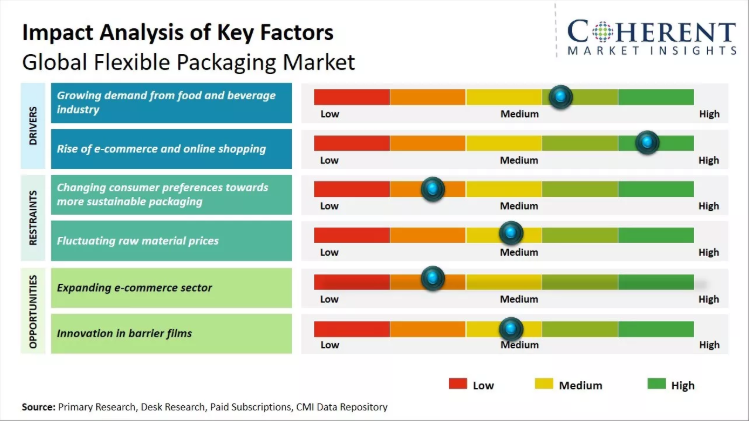
The increasing demand for flexible packaging from the food & beverage industry is the major factor driving the market growth. Flexible packaging provides advantages like durability, lightweight, and reusability. Moreover, flexible packaging produces less waste and uses fewer resources compared to rigid packaging. Rising environmental concerns are increasing the demand for flexible packaging as it is recyclable and produces less garbage. The growing e-commerce industry globally is another factor fueling the growth of the flexible packaging market. However, the availability of substitutes like molded fiber packaging and paper bags may hinder the market growth of flexible packaging.
Flexible Packaging Market Insights, By Material:
Plastic Dominates Due To Its Affordability, Versatility, And Broad Industrial Applicability
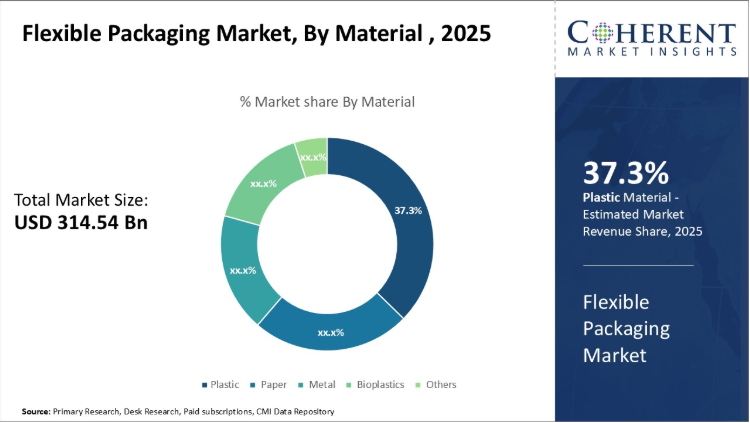 In terms of material, plastic contributes 38.3% of the market share in 2026 of the market owning to its affordability and variety of applications. Being a versatile material, plastic can be easily molded into various forms and shapes. This allows flexible plastic packaging to protect a wide range of products across industries.
From food and beverages to pharmaceuticals and personal care, plastic packaging fulfills the needs of numerous ends uses effectively. The affordability of plastic makes it an attractive solution for both manufacturers and consumers. Compared to other materials like paper and metal, plastic has a lower raw material and production cost. This cost-efficiency enables companies to package their goods at reasonable prices without major impact on profit margins.
Lower packaging costs are eventually passed on to consumers in the form of affordable prices. Affordability facilitates greater product accessibility, growing plastic's applicability. Plastic materials like polyethylene (PE), polypropylene (PP), and polyethylene terephthalate (PET) offer advantages like durability, printability, and moisture resistance. Their barrier properties protect the products from external factors like humidity and contamination.
Plastic resins also give packaging designers creative freedom to develop custom container shapes, sizes, and graphics as per brand needs. This drives brand differentiation and marketing on shelves. The development of bio-plastic variants has further augmented plastic's versatility. Bio-plastics derived from renewable plant-based sources bring the same functionality with lower eco-footprint. Their biodegradability addresses sustainability concerns regarding plastic waste. Such innovations will aid plastic's continued dominance in the packaging spectrum.
For instance, in September 2025, TIPA unveiled a breakthrough in compostable packaging, introducing a transparent laminate that mimics conventional plastic while remaining fully compostable. This innovation enables high-performance, eco-friendly flexible packaging for food and fashion applications, aligning with global sustainability goals and regulatory shifts. The development marks a significant step toward replacing petroleum-based films with biodegradable alternatives.
In terms of material, plastic contributes 38.3% of the market share in 2026 of the market owning to its affordability and variety of applications. Being a versatile material, plastic can be easily molded into various forms and shapes. This allows flexible plastic packaging to protect a wide range of products across industries.
From food and beverages to pharmaceuticals and personal care, plastic packaging fulfills the needs of numerous ends uses effectively. The affordability of plastic makes it an attractive solution for both manufacturers and consumers. Compared to other materials like paper and metal, plastic has a lower raw material and production cost. This cost-efficiency enables companies to package their goods at reasonable prices without major impact on profit margins.
Lower packaging costs are eventually passed on to consumers in the form of affordable prices. Affordability facilitates greater product accessibility, growing plastic's applicability. Plastic materials like polyethylene (PE), polypropylene (PP), and polyethylene terephthalate (PET) offer advantages like durability, printability, and moisture resistance. Their barrier properties protect the products from external factors like humidity and contamination.
Plastic resins also give packaging designers creative freedom to develop custom container shapes, sizes, and graphics as per brand needs. This drives brand differentiation and marketing on shelves. The development of bio-plastic variants has further augmented plastic's versatility. Bio-plastics derived from renewable plant-based sources bring the same functionality with lower eco-footprint. Their biodegradability addresses sustainability concerns regarding plastic waste. Such innovations will aid plastic's continued dominance in the packaging spectrum.
For instance, in September 2025, TIPA unveiled a breakthrough in compostable packaging, introducing a transparent laminate that mimics conventional plastic while remaining fully compostable. This innovation enables high-performance, eco-friendly flexible packaging for food and fashion applications, aligning with global sustainability goals and regulatory shifts. The development marks a significant step toward replacing petroleum-based films with biodegradable alternatives.
Flexible Packaging Market Insights, By Product Type:
Stand-Up Pouches Lead Is Driven by Space Efficiency, Cost Savings, And Strong Shelf Appeal
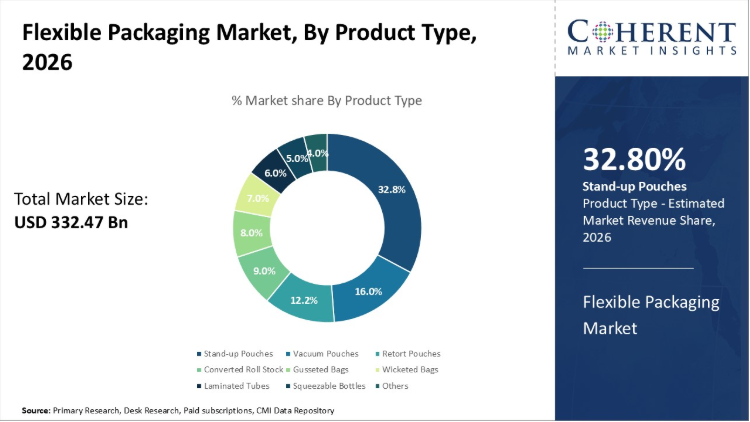 In terms of product type, stand-up pouches segment contributes 32.8% of the market share in 2026. Stand-up pouches maximize space utilization due to their three-dimensional shape. More product can be packed in lesser space, improving load per truck or shipping container. This directly cuts transportation and logistics costs. Being self-standing, stand-up pouches do not require extra packaging material like boxes. Their peel-open feature provides easy access to contents without additional utensils like boxes. This enhances consumer convenience during use.
Stand-up pouches are ideally suited for powders, liquids and snacks which are accessed regularly. From a manufacturing point of view, stand-up pouches require less raw material compared to rigid alternatives. Their use of laminated web rolls and form-fill-seal technology makes production highly automated with better speeds. This reduces per piece costs. Stand-up pouches are recyclable and optionally come with re-sealable zippers or pouring fits depending on product needs.
Brands recognize the shelf-popping visibility provided by stand-up pouches due to their upright showcase format. Vibrant graphics and customer messaging can be leveraged for strong on-shelf appeal and impulse buying. Top brands across food, pet care, and other segments are switching to stand-up pouches for their competitive edge in busy retail aisles.
For instance, in February 2025, Mondi and Proquimia launched paper-based stand-up pouches for dishwashing tablets, replacing traditional plastic packaging with recyclable fiber-based alternatives. The innovation supports sustainability goals while maintaining product protection and shelf appeal. This marks a significant advancement in eco-friendly flexible packaging for home care products, aligning with growing consumer demand and regulatory pressure for recyclable materials.
In terms of product type, stand-up pouches segment contributes 32.8% of the market share in 2026. Stand-up pouches maximize space utilization due to their three-dimensional shape. More product can be packed in lesser space, improving load per truck or shipping container. This directly cuts transportation and logistics costs. Being self-standing, stand-up pouches do not require extra packaging material like boxes. Their peel-open feature provides easy access to contents without additional utensils like boxes. This enhances consumer convenience during use.
Stand-up pouches are ideally suited for powders, liquids and snacks which are accessed regularly. From a manufacturing point of view, stand-up pouches require less raw material compared to rigid alternatives. Their use of laminated web rolls and form-fill-seal technology makes production highly automated with better speeds. This reduces per piece costs. Stand-up pouches are recyclable and optionally come with re-sealable zippers or pouring fits depending on product needs.
Brands recognize the shelf-popping visibility provided by stand-up pouches due to their upright showcase format. Vibrant graphics and customer messaging can be leveraged for strong on-shelf appeal and impulse buying. Top brands across food, pet care, and other segments are switching to stand-up pouches for their competitive edge in busy retail aisles.
For instance, in February 2025, Mondi and Proquimia launched paper-based stand-up pouches for dishwashing tablets, replacing traditional plastic packaging with recyclable fiber-based alternatives. The innovation supports sustainability goals while maintaining product protection and shelf appeal. This marks a significant advancement in eco-friendly flexible packaging for home care products, aligning with growing consumer demand and regulatory pressure for recyclable materials.
Flexible Packaging Market Insights, By Application:
Food & Beverage Is Driven by Diverse, Evolving Packaging Needs and Lifestyle Shifts
In terms of application, the food & beverage segment contributes 38% share of the market in 2026 owing to extensive packaging needs. As lifestyles evolve with changing consumer demands, the packaging format preferences are also undergoing rapid change. Flexible pouches and bags fit the bill perfectly. From snacks to frozen meals and pet food, flexible packaging variations like stand-up pouches, spiral wound bags, and flow-wraps pack diversity. Their barrier properties protect contents across the fresh, frozen, and perishable categories. Beverage manufacturers leverage flexible packs for point-of-sale shipment and store displays. Pouches and aseptic bags enable the transport of liquids while occupying less space than glass or rigid containers. Shelf-stable formats keep products fresh. Customizable bag-in-box solutions benefit food service players. Flexible laminates and coextrusions meet regulatory standards for direct food contact. Rising health-consciousness is shifting diets towards portable packaged products with transparent labeling. Flexible pouches cater to this lifestyle need through functional attributes like re-closability, dip-spoon inserts, and dispensing nozzles. Their applications in nutraceuticals, vitamins, and meal replacement supplements also see strong growth. The growing frozen food segment looks up to flexible laminates barrier properties against moisture, oxygen, and light. This helps extend the shelf-life of ready-to-cook meals, vegetables, and snacks without refrigerator needed at point-of-sale or consumption. Given the diverse packaging demand, the food and beverage industry will continue powering the flexible packaging market. For instance, in June 2025, UFlex Ltd launched a single-pellet rPET solution for food and beverage packaging, streamlining production of sustainable flexible packaging. The innovation combines recycled content with food-grade compliance, reducing complexity for converters and supporting circular economy goals. This marks a significant step toward scalable, eco-friendly packaging in high-volume consumer segments.

